
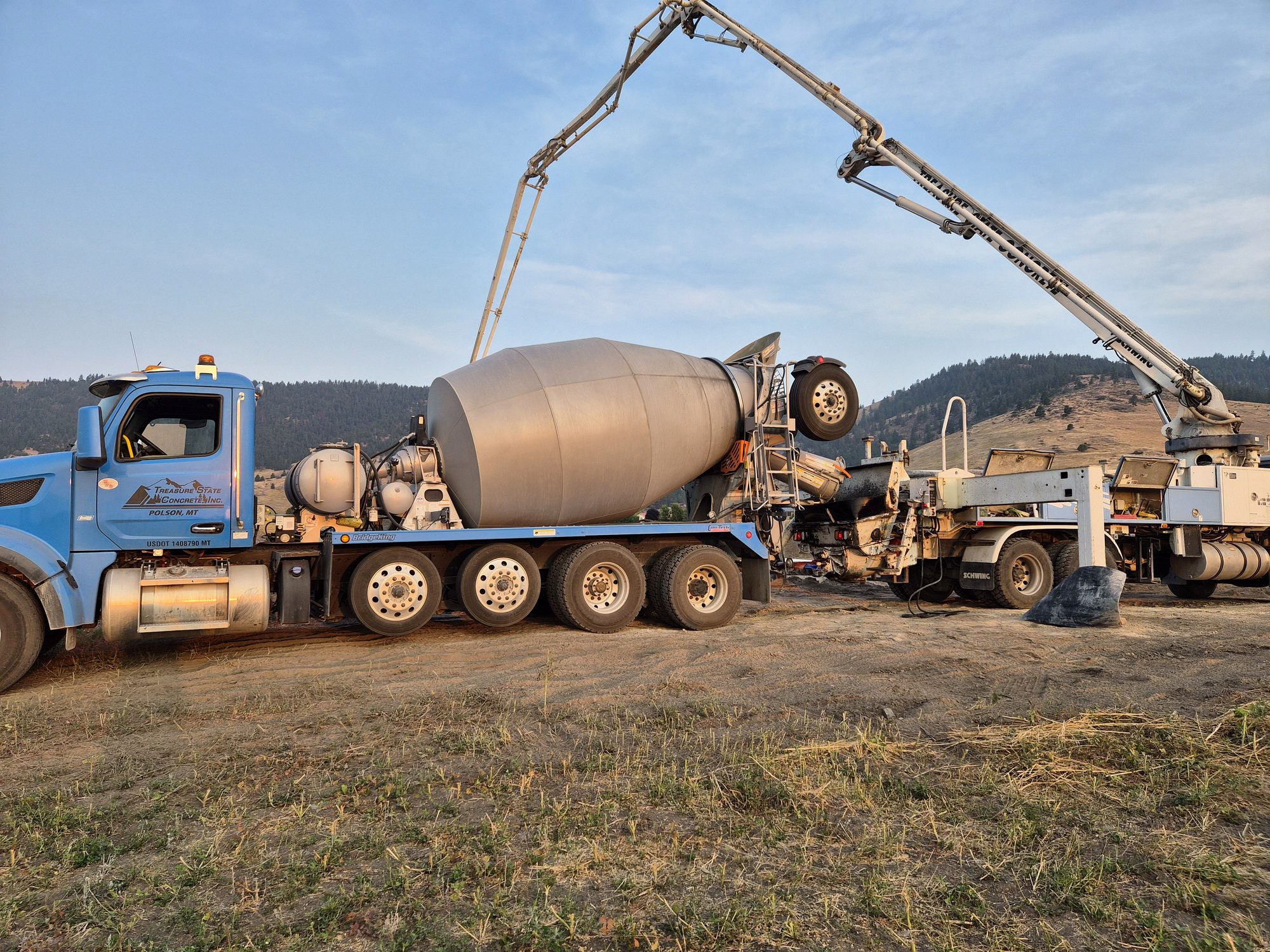
Mixer trucks and other material delivery trucks have substantial blind spots. Their size, weight, turning path, operating equipment, and jobsite conditions demand one clear communication path between the customer's designated ground guide and the driver.
This guide explains our ground guide requirement; it is not a site inspection, professional training program, engineering opinion, or guarantee that a route is suitable. Applicable law, the site safety plan, approved plans and specifications, and the controlling quote, order, delivery ticket, and sales terms still apply.
Treasure State Concrete, Inc. policy
Provide a ground guide whenever the truck operates on the jobsite.
A ground guide is required whenever a Treasure State Concrete, Inc. truck operates on the jobsite. The customer must provide one designated ground guide who is a competent adult whenever a Treasure State Concrete, Inc. truck leaves a maintained public road or moves, backs, unloads, spreads, or otherwise operates on the jobsite. That person's only job during truck movement is to guide the driver and watch the path, people, property, clearances, and known site hazards.
If the required ground guide is absent, distracted, unable to communicate clearly, or placed where the driver cannot see them, the driver may stop, change, or refuse the requested access, movement, setup, unloading, spreading, or placement plan.
Before the truck arrives
Walk the complete route and disclose what the driver cannot know.
Start at the maintained public road and follow the intended path through the entrance, gates, turns, grades, backing areas, setup point, unloading or discharge location, and exit. The designated ground guide must understand the path before giving directions.
- Identify soft, wet, thawing, recently excavated, filled, undermined, or uncompacted ground.
- Mark pavement edges, shoulders, slopes, drop offs, weak driveways, culverts, bridges, slabs, and other questionable support.
- Disclose known or suspected utilities, septic components, wells, vaults, old trenches, irrigation, and concealed structures.
- Check gates, turning room, backing room, overhead lines, branches, rooflines, scaffolding, equipment, and stored material.
- Choose no go areas and keep people, pets, traffic, and unnecessary equipment away from the route.
Directions from the ground guide confirm that the requested path has been inspected and that known hazards and no go areas have been disclosed. A surface that supports a pickup or passenger vehicle may not support a loaded material truck, and weather or site work may change conditions after the route walk.
See what the driver cannot
Stay out of blind spots while watching the whole travel path.
A driver cannot continuously see every area in front of, beside, and behind a large truck. Mirrors, cameras, alarms, and sensors may help, but none replaces an attentive ground guide or makes it safe to enter the truck's path.
Stand where the driver can see you
Before movement begins, confirm which mirror the driver will use. Remain in that mirror, outside the truck's path and away from pinch points, operating equipment, drop offs, and other hazards.
Watch beyond the bumper
Monitor people, traffic, structures, utilities, ground, clearances, swing and turning space, blind areas, and property that could be damaged as the truck moves or operates.
One communication path
Designate one guide and keep everyone else out of the conversation.
The driver and customer must identify one ground guide before the truck moves. Other workers, owners, and bystanders must not give competing directions. The guide may not use a cell phone, wear personal headphones, operate equipment, carry material, direct another vehicle, or perform unrelated work while guiding the truck. The guide must work without distractions.
If the designated guide must leave, the truck stops. The driver and customer must identify the replacement, review the route and hazards, and agree on signals before movement resumes.
Agree before movement
Use large, clear hand signals that the driver understands.
The ground guide and driver must agree on clear signals before movement or backing begins. Signals must be deliberate, visible, and given only by the designated guide. Never assume a gesture means the same thing to every driver.
These suggested signals are a starting point, not a universal signal system or a substitute for agreeing on every signal before the truck moves:
- Back up: motion both hands toward the guide.
- Back, turn left: clearly indicate the direction and backing motion.
- Back, turn right: clearly indicate the direction and backing motion.
- Move forward: motion both hands away from the guide.
- Distance left to back: show the remaining distance with wide, visible hand spacing.
- Slow down: use a deliberate downward motion.
- Stop: use the agreed, unmistakable stop signal.
The driver must be able to see the ground guide in the agreed mirror throughout movement. The driver stops immediately if the driver loses sight of the ground guide or visual contact is lost, receives an unclear or conflicting signal, or cannot confirm that the path remains clear. The ground guide must reestablish a visible, safe position and clear communication before movement resumes.
OSHA's backing safety solutions recommend that drivers and guides agree on signals, maintain visual contact, stop when contact is lost, and keep the guide free of additional duties and personal distractions. OSHA notes that those solutions are informational and are not, by themselves, requirements of every OSHA standard. Treasure State Concrete, Inc.'s ground guide requirement is a separate company policy for our jobsite deliveries.
Understand what the guide can and cannot do
A ground guide reduces avoidable risk; they cannot guarantee no damage.
Good planning and clear signals can help, but they do not guarantee perfect access, uninterrupted delivery, exact placement, or a damage free result. Ground can fail, concealed features can be missed, weather can change, and trucks need space to turn, back, discharge, and leave.
If delay, recovery, towing, returned material, or property damage is caused by a customer controlled site condition, customer direction, a known hazard that was not disclosed, or failure to provide the required ground guide, responsibility is determined under applicable law and the controlling written terms and only to the extent that condition, direction, nondisclosure, or failure caused the loss. Nothing in this guide waives liability to the extent caused by Treasure State Concrete, Inc.'s own negligence or misconduct, or any right or responsibility that may not lawfully be waived.
Recheck immediately before delivery
Confirm the guide, route, hazards, and communication plan again.
- One competent adult ground guide is present and has no other duties.
- The guide and driver have identified each other and agreed on clear hand signals.
- The guide knows which mirror the driver will use and has a safe, visible position.
- The route, setup area, unloading point, no go areas, and exit have been walked.
- Known ground, underground, overhead, side clearance, people, traffic, and property hazards are disclosed and marked.
- Weather and work performed since the route walk have not changed the ground or access plan.
- Everyone understands that the driver stops when contact is lost or signals are unclear and retains final authority to refuse the requested movement.