Asphalt is the visible surface, but the soil, aggregate base, drainage, grade, and compaction below it help determine how the pavement carries traffic and holds its shape. A good paving crew can place a smooth mat. It cannot make buried organic material, trapped water, pumping soil, or an unstable base disappear.
Soil, groundwater, frost exposure, intended traffic, local requirements, and project design all affect preparation. This guide does not establish a universal excavation depth, base or asphalt thickness, slope, density target, test method, or acceptance standard for a particular property.
Look below the black surface
Asphalt pavement works as a complete structure.
The prepared soil is the subgrade. Suitable aggregate may be placed above it as subbase or base, followed by the asphalt courses. The layers work together to distribute wheel loads, provide uniform support, manage water, and resist seasonal changes.
The Federal Highway Administration explains that a pavement needs a subgrade that is uniform, sufficiently stiff, strong, and stable. FHWA also identifies insufficient base or subgrade strength and moisture or drainage problems as contributors to flexible pavement rutting, cracking, depressions, roughness, and potholes. Read the official FHWA pavement design guidance.
Asphalt follows the prepared grade. It can create a finished surface, but it is not a substitute for correcting weak support, widespread grade errors, or uncontrolled water below the mat.
Shape the foundation first
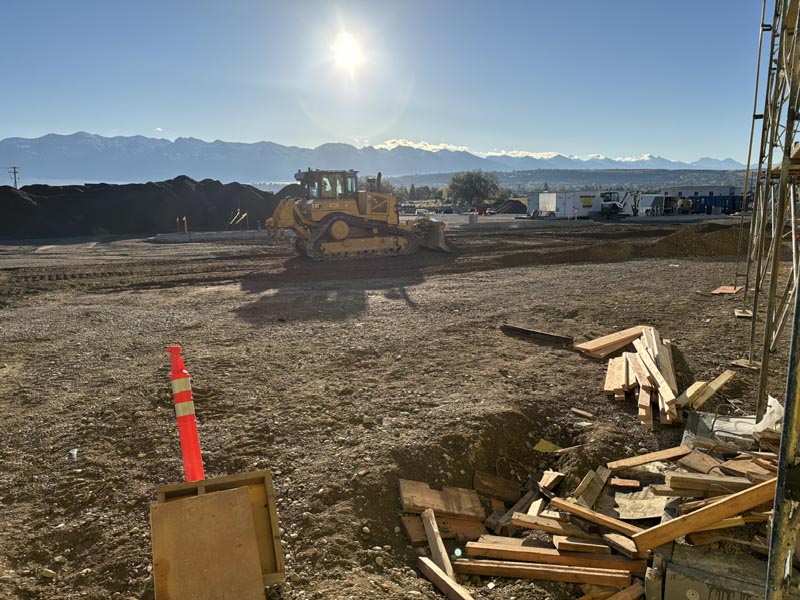
The base establishes the profile the paving crew receives.
Elevations, cross slope, transitions, and drainage need to be established before asphalt placement. A low, wavy, or rutted base can create inconsistent asphalt thickness and make it harder to produce a uniform finished surface.
FHWA research identifies base surface preparation as critical to initial asphalt smoothness and recommends checking the base grade before paving. The goal is not cosmetic perfection. It is a stable, uniform surface built to the intended lines, grades, and drainage plan. Review the FHWA pavement smoothness report PDF.
Give water a path out
Surface and subsurface drainage must be considered together.
Water can arrive through rainfall, snowmelt, irrigation, roof runoff, uphill seepage, pavement edges, cracks, or groundwater. If it collects in the aggregate or subgrade, it can reduce support and amplify freeze and thaw movement.
Plan positive surface drainage to a legal, approved outlet and evaluate where subsurface water can move. Avoid creating a bathtub a low area in the foundation where water has no reliable way to escape. Ditches, culverts, edge drainage, underdrains, grading, or other measures may be appropriate, but the answer is site specific.
See how Treasure State Concrete, Inc. approaches site grading, drainage, utility coordination, and paving preparation on our civil construction page.
Do not bury the warning signs
Unsuitable and unstable material needs attention before it is covered.
Vegetation, topsoil, roots, buried organic matter, mud, frozen material, uncontrolled fill, and soft zones can create uneven support. During preparation, watch how the surface responds to excavation equipment, delivery trucks, graders, and compactors. Rutting, weaving, pumping, or water squeezing to the surface are reasons to stop and identify the cause.
Depending on the condition and governing design, corrective work may include drying and reworking, undercutting and replacement, drainage improvements, stabilization, or an engineered separation or reinforcement system. Fabric or geogrid is not an automatic cure and does not replace proper subgrade preparation.
Montana Department of Transportation highway specifications illustrate the same construction principle: additional aggregate is not placed over a surface that fails its density, grade, or smoothness requirements, is rutted or frozen, or contains unstable or pumping material. Residential and private work is governed by its own scope and requirements; the highway specification is a useful example, not a driveway recipe. Use the current MDT Standard Specifications hub for the edition controlling an MDT project.
Place a uniform, compacted layer
The right aggregate still has to be handled correctly.
A suitable crushed aggregate base can strengthen the pavement structure, reduce stress reaching the subgrade, provide a more uniform paving platform, and contribute to drainage and frost protection. Product selection should reflect the plan, specification, soil, water conditions, and expected traffic.
Base is normally placed in manageable lifts and compacted with equipment suited to the material and support below it. Moisture conditioning matters: material that is too dry may resist uniform densification, while saturated material may shove, pump, or rut. A smooth looking top does not prove that the full layer is uniform or adequately compacted.
Read our guide to aggregate base segregation and moisture, then explore available materials, pickup, and delivery on the aggregate and pit storefront page.
Verify before covering
Proof rolling can reveal problems, but it is not the whole quality plan.
FHWA describes proof rolling as a way to identify gross soft, yielding, or pumping areas. A qualified contractor, inspector, or project professional observes the surface response under suitable equipment and follows the project's criteria for investigation and correction.
Proof rolling is observer dependent and does not replace proper placement, moisture control, compaction, inspection, or required testing. Equipment must also be appropriate for the support; excessive loading can damage an already weak foundation. Larger, commercial, public, or heavily loaded work may require documented density, moisture, stiffness, or other acceptance testing.
FHWA discusses proof rolling, compaction methods, moisture density relationships, weak area correction, and construction monitoring in its Geotechnical Aspects of Pavements construction chapter.
Review the work while it is still visible
Questions to answer before the first asphalt truck arrives.
- What vehicles and axle loads will regularly use the pavement?
- Have utilities, organics, unsuitable fill, and soft areas been addressed?
- Where will surface water and subsurface water go?
- Does the base hold the intended line, grade, cross slope, and transitions?
- Is the specified aggregate uniformly placed without mud or obvious segregation?
- Has each course received the required moisture control and compactive effort?
- Are rutting, yielding, pumping, or standing water absent or formally corrected?
- Have required proof roll, inspection, density, moisture, and grade checks been completed?
- Does the written scope state compacted layer thicknesses and responsibility for unforeseen weak areas?
Garbage trucks, delivery vehicles, construction equipment, RVs, fire apparatus, and repeated commercial traffic may require a different pavement structure than passenger cars. Share the real use with the estimator before preparation begins.
Treasure State Concrete, Inc. provides grading, aggregate base preparation, hot mix asphalt paving, and related civil work. See our paving capabilities and bring us the location, intended use, drainage concerns, access, drawings or specifications, and requested schedule.